русский
 中文简体
中文简体 Español
 Deutsch
 عربى
عربىContent
- 1 How an Extruder Works: The Core Operating Principle
- 2 What Is a Cable Strip Extruder and How Does It Differ From a Main Extruder?
- 3 What Types of Cables Require a Strip Extruder?
- 4 Key Process Advantages of Using a Cable Strip Extruder
- 5 Compatible Materials for Cable Strip Extruders
- 6 How a Cable Strip Extruder Integrates Into a Complete Production Line
- 7 What to Evaluate When Sourcing a Cable Strip Extruder
- 8 Conclusion: The Extruder's Role From Insulation to Identification
An extruder is a machine that forces molten material through a shaped die to continuously form a product with a defined cross-section. In wire and cable manufacturing, extruders are the core equipment responsible for applying insulation, sheathing, and identification color layers directly onto metal conductors. The output is a uniformly coated cable that meets precise dimensional, electrical, and identification standards required by international wiring codes.
Within a cable production line, extruders are deployed at multiple stages — from primary insulation to outer jacketing and color coding. One specialized variant that plays a critical but often overlooked role is the cable strip extruder, also called a color strip extruder or auxiliary extruder. Unlike the main extruder that forms the insulation layer, a cable strip extruder co-extrudes a narrow longitudinal color stripe onto the cable surface for identification purposes. The sections below explain how extruders function in cable production, what distinguishes a cable strip extruder from other extruder types, and the key parameters buyers should evaluate when sourcing this equipment.
How an Extruder Works: The Core Operating Principle
Every cable extruder — regardless of size or application — operates on the same fundamental principle. Raw thermoplastic material in pellet or granule form is fed into a hopper, from which it enters a heated barrel. Inside the barrel, a rotating screw conveys the material forward while compressing and shearing it. The combination of mechanical friction and external barrel heating raises the material to a molten state, typically between 150 °C and 220 °C depending on the polymer compound being processed.
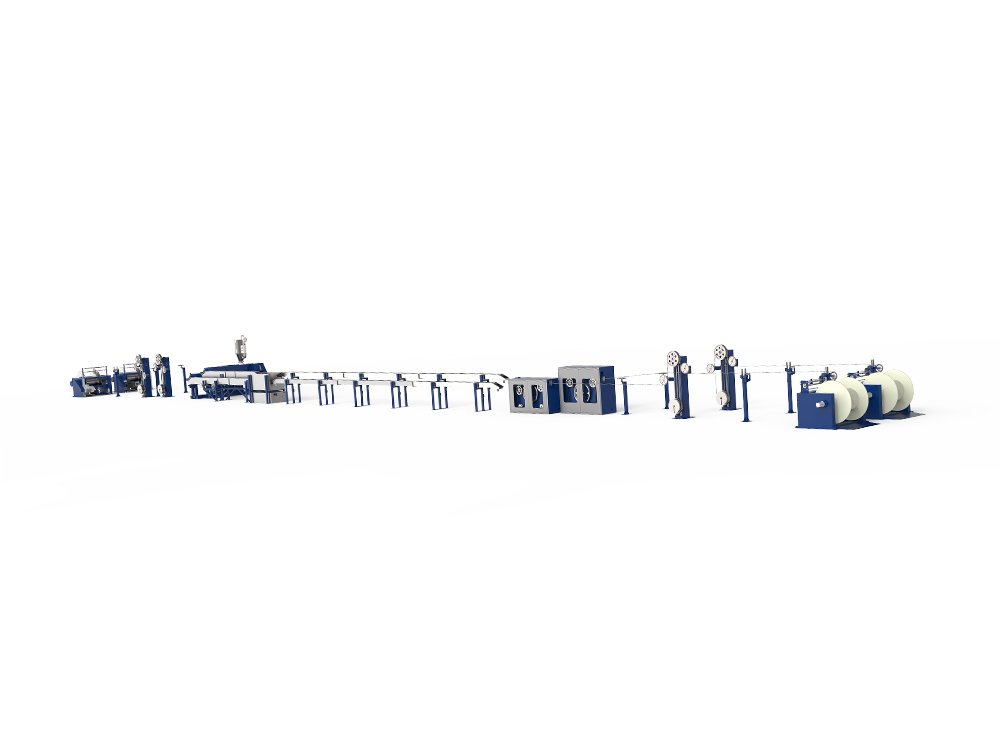
The molten material is then forced under pressure through a crosshead die mounted at the extruder outlet. The crosshead guides the moving conductor through the center of the die while the melt flows around it, forming a continuous, concentric insulation coating. After exiting the die, the coated cable passes through a cooling water trough, which rapidly solidifies the plastic to lock in the correct diameter and surface finish. Downstream equipment — including a haul-off caterpillar, diameter gauge, spark tester, printer, and take-up reel — completes the production line.
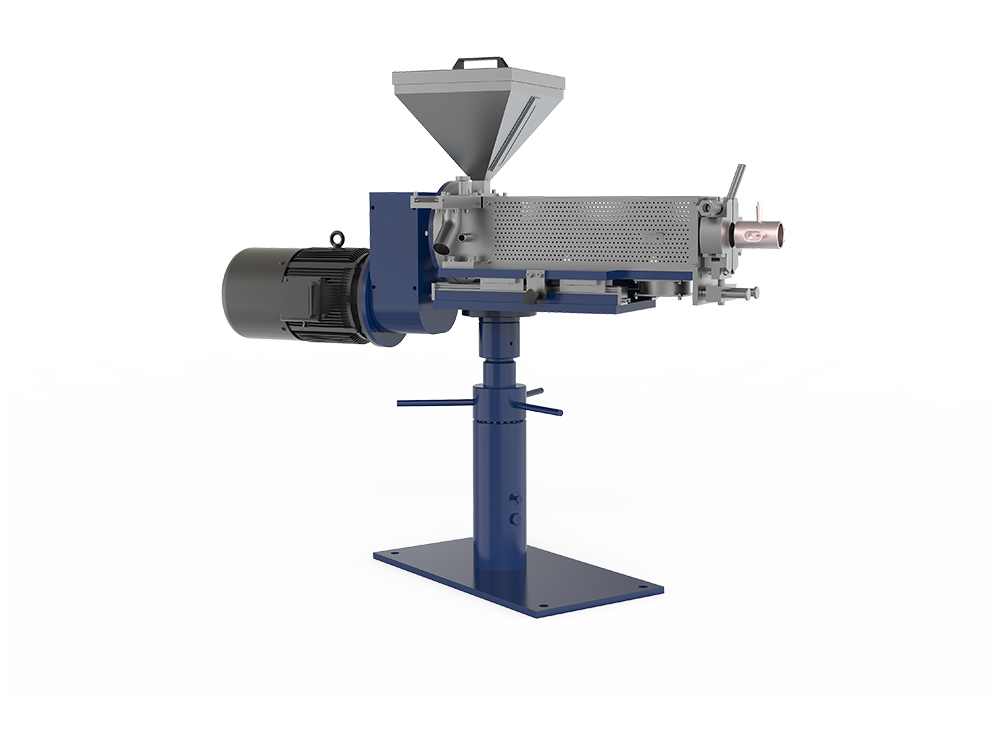
The screw is the most performance-critical component of any extruder. Screw diameter — expressed in millimeters, such as Ø35, Ø45, Ø65, or Ø90 — directly determines the machine's output volume and the range of cable sizes it can produce. Larger screw diameters deliver higher throughput but require proportionally greater barrel heating capacity and drive motor power. For cable strip extruders, which apply only a thin decorative or identification layer rather than a full insulation wall, compact screw diameters in the Ø25 to Ø45 range are standard.
What Is a Cable Strip Extruder and How Does It Differ From a Main Extruder?
A cable strip extruder is a compact auxiliary extruder designed to apply one or more narrow longitudinal color stripes — typically 0.5 mm to 2 mm wide — onto the surface of a cable as it exits the main extruder's crosshead. It operates in tandem with the main extruder, injecting a small volume of differently colored thermoplastic compound into a dedicated port in the crosshead, where it bonds to the outer surface of the main insulation layer as both materials are simultaneously extruded.
The primary purpose of these color stripes is circuit identification. International wiring standards — including IEC 60446, NEC, and BS 7671 — mandate color coding for phase conductors, neutral conductors, and protective earth (ground) conductors to ensure safe installation and maintenance. Rather than manufacturing each cable variant in a fully solid color — which requires a complete material change, purging of the extruder, and significant production downtime — manufacturers use a strip extruder to add color identification stripes over a base color insulation, typically white or black. This approach dramatically reduces material cost and changeover time.
Because the colored stripe compound is applied in a very small quantity compared to the main insulation layer, cable producers can use premium color masterbatch in the strip extruder while keeping the bulk of the insulation in a lower-cost natural or base-color compound. This cost structure makes strip extrusion the preferred identification method for high-volume building wire and power cable production worldwide.
| Feature | Main Cable Extruder | Cable Strip Extruder |
|---|---|---|
| Primary function | Apply full insulation or sheath layer | Apply longitudinal color identification stripe |
| Typical screw diameter | Ø45 mm – Ø150 mm+ | Ø25 mm – Ø45 mm |
| Material throughput | High — full wall thickness | Low — narrow strip only |
| Operation mode | Standalone or as part of tandem line | Always paired with main extruder crosshead |
| Color change capability | Requires full purge — significant downtime | Fast — small material volume purges quickly |
| Compatible materials | PVC, PE, XLPE, LSZH, TPU, Nylon, PP | PVC, PE, PP, XLPE, LSZH, Nylon |
| Number of stripes | N/A | Single or double stripe per crosshead port |
What Types of Cables Require a Strip Extruder?
Strip extrusion is used across a broad range of cable categories wherever longitudinal color marking is preferred or required over full-color insulation or ink printing. The following cable types routinely incorporate strip extruder operations in their production lines.
- Building wires (residential and commercial wiring): Single-core conductors for fixed electrical installations typically use color-coded insulation to identify phase, neutral, and earth conductors. Strip extrusion allows a white or black base insulation to carry a green, yellow, blue, or brown stripe that satisfies IEC 60446 and regional wiring regulations without changing the entire insulation material batch.
- Low voltage power cables (0.6/1 kV and below): Multi-core power cables with individually insulated cores use color-coded cores for conductor identification. Strip extrusion on the individual core insulation step is common in high-volume production where solid-color material changeover would create excessive waste and line stoppages.
- Flexible cords and appliance wiring material (AWM): Flexible cables for consumer electronics, home appliances, and power tools use strip identification on fine-stranded conductors where printed ink marking may not provide sufficient durability during repetitive flexing.
- Automotive wiring harnesses: Vehicle wire harnesses require precise conductor identification across large harness assemblies. Strip extruded color coding provides a durable, abrasion-resistant identification method that retains legibility over the cable's service life, even in high-temperature engine compartment environments when the strip material is specified accordingly.
- Control and instrumentation cables: Multi-pair control cables for industrial automation and instrumentation use colored stripes to identify individual pairs within a multi-conductor assembly, simplifying field termination and maintenance.
Key Process Advantages of Using a Cable Strip Extruder
The decision to use strip extrusion rather than alternative color identification methods — such as solid-color insulation, ink printing, or spiral wrapping — is driven by a combination of cost, production efficiency, and durability factors.
Material Cost Reduction
Colored PVC or XLPE compound carries a significantly higher raw material cost than natural or base-color compound due to the pigment system and color-matching requirements. By applying color only as a narrow surface stripe — which may represent as little as 1–3% of the total insulation wall volume — cable manufacturers can use natural or white compound for the bulk of the insulation while reserving the color compound exclusively for the identification stripe. Over high-production volumes, this material cost differential delivers meaningful savings per kilometer of finished cable.
Fast Color Changeover Without Line Stoppage
Changing from one conductor color to another using solid-color insulation requires draining the main extruder barrel, purging the residual compound, loading the new color, and stabilizing processing conditions — a process that can take 20–40 minutes and generates substantial scrap. A cable strip extruder operates with a very small barrel and screw volume, so the color change purge is completed in a fraction of that time with minimal material waste. This capability is particularly valuable for manufacturers producing multiple conductor colors on the same production line in short run batches.
Superior Identification Durability Compared to Ink Printing
Ink-based color identification applied by an inline printer can fade, abrade, or peel when cables are routed through conduit or subjected to chemical exposure. An extruded color stripe, by contrast, is a continuous thermoplastic layer bonded to the insulation surface during the extrusion process — it has the same abrasion resistance and chemical compatibility as the insulation itself. This makes extruded stripe identification the preferred method for cables in industrial environments where long-term marking integrity is essential.
Compatible Materials for Cable Strip Extruders
A cable strip extruder must process the same or a closely compatible thermoplastic compound as the main extruder, since the stripe material bonds to the main insulation layer at the crosshead. Compatibility in processing temperature, melt viscosity, and thermal expansion coefficient is necessary for a clean, well-defined stripe edge without delamination or halo effects around the stripe boundary.
| Material | Processing Temperature | Typical Cable Application | Key Property for Strip Use |
|---|---|---|---|
| PVC (flexible) | 160 °C – 185 °C | Building wire, flexible cord, control cable | Excellent colorability, low cost |
| PE (polyethylene) | 170 °C – 200 °C | Low voltage power cable, outdoor cable | Good chemical resistance, UV stability |
| XLPE | 200 °C – 220 °C | Medium/high voltage power cable | High thermal rating, superior dielectric |
| LSZH / LSHF | 180 °C – 210 °C | Tunnel, metro, marine, data center cable | Zero halogen, low smoke emission |
| Nylon (PA) | 230 °C – 260 °C | Nylon-jacketed building wire (NM-B type) | Abrasion and oil resistance |
| PP (polypropylene) | 200 °C – 240 °C | Automotive wire, appliance wiring | Stiffness, heat resistance |
How a Cable Strip Extruder Integrates Into a Complete Production Line
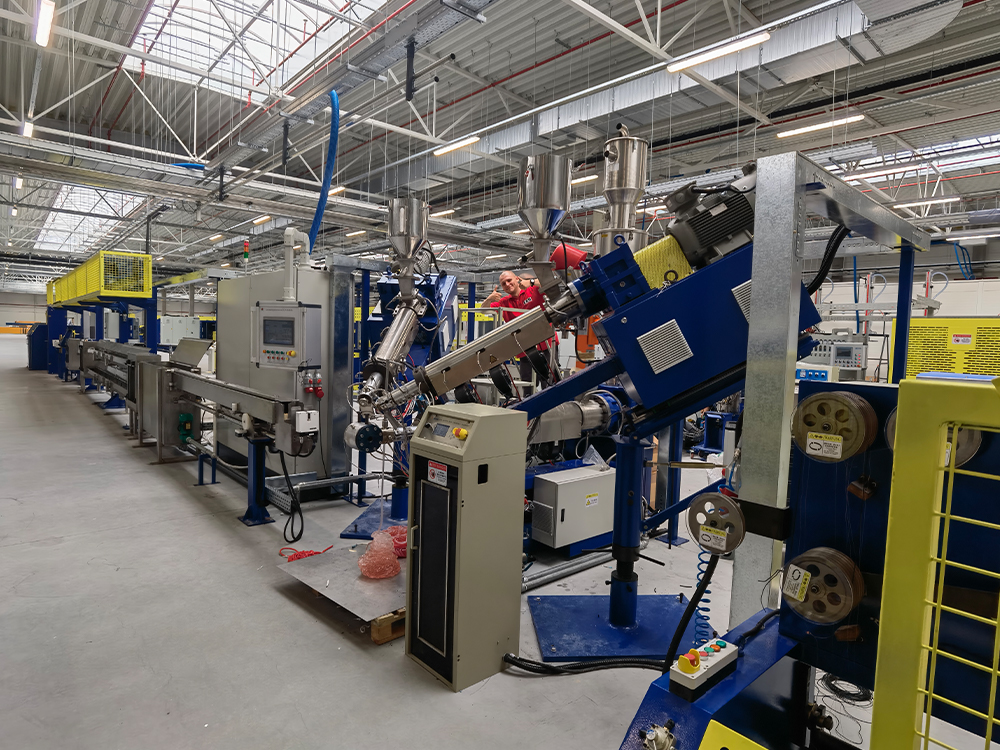
A cable strip extruder does not operate as a standalone machine. It is always configured as a peripheral unit attached to the crosshead of the main extruder, connected via a short melt channel or injection port that feeds the strip compound directly into the crosshead flow path at the correct angle and position to form the surface stripe. The physical installation is compact — most strip extruders are mounted on a mobile stand or cantilevered bracket that allows them to be positioned against or aligned with the main extruder crosshead without a fixed floor footprint, providing installation flexibility.
The strip extruder screw speed is controlled independently and must be synchronized with the main line speed to maintain consistent stripe width and continuity. On modern production lines, this synchronization is managed by the line's PLC control system, which receives a speed reference signal from the main haul-off caterpillar and adjusts strip extruder output accordingly. If the strip extruder speed drifts out of synchronization with line speed, the stripe width will vary or the stripe may break — both of which constitute a quality non-conformity that requires the affected cable length to be scrapped or re-identified.
For production lines manufacturing cables requiring two color stripes — such as a yellow and green stripe combination for earth conductors in certain markets — two strip extruders are installed on the same crosshead, each feeding a separate injection port positioned at the correct angular relationship around the cable circumference.
What to Evaluate When Sourcing a Cable Strip Extruder
For cable manufacturers and equipment procurement engineers evaluating cable strip extruders, the following technical and commercial parameters should be reviewed before placing a sourcing order.
- Screw diameter and L/D ratio: The screw diameter must match the output required for the stripe volume at the intended line speed. A larger L/D ratio (length-to-diameter ratio) — typically 20:1 to 25:1 for strip extruders — provides better melting and homogenization, especially when processing color masterbatch compounds.
- Temperature control zones: Multi-zone barrel temperature control with independent PID controllers for each zone ensures stable melt temperature and consistent stripe compound viscosity. A minimum of three control zones — feed, compression, and metering — is recommended for stripe quality consistency.
- Drive and speed range: The strip extruder drive must cover the full speed range of the main line without hunting or instability. Variable frequency drive (VFD) control is standard on modern equipment and provides the fine speed resolution needed for stripe width consistency at both low and high line speeds.
- Crosshead compatibility: The strip extruder's melt injection geometry must be matched to the specific crosshead design used on the main extruder. Suppliers who provide strip extruders as part of a complete crosshead and auxiliary extruder package eliminate integration risk.
- Material compatibility and screw design: If the production line processes both PVC and halogen-free compounds, confirm that the strip extruder barrel and screw materials are compatible with the corrosive degradation products of PVC at elevated temperatures, or that the machine is designed for dedicated single-material use.
- OEM and customization support: Many cable production lines require non-standard crosshead configurations, specific stripe widths, or integration with existing PLC architectures. Manufacturers offering OEM customization and on-site commissioning support reduce project risk, particularly when integrating strip extruders into existing production lines rather than new greenfield installations.
Conclusion: The Extruder's Role From Insulation to Identification
Extruders are the functional heart of every cable production line — they melt, homogenize, and precisely apply thermoplastic materials to form the insulation and sheathing layers that define a cable's electrical, mechanical, and fire performance. Within this broader context, the cable strip extruder addresses a specific but commercially important requirement: applying durable, code-compliant color identification stripes at production speed without the cost and downtime penalty of solid-color material changes.
For cable manufacturers sourcing strip extruder equipment, the critical evaluation criteria are screw specification relative to line speed requirements, temperature control resolution, crosshead integration compatibility, and supplier capability for OEM configuration and post-installation technical support. Selecting equipment that delivers consistent stripe geometry and reliable synchronization with the main line is the foundation for producing identification-compliant cable that meets international standards with minimal material waste and rework.